The central problem
Clients demand bold visual impact on glass façades, atria and factory lobbies, yet they expect natural light, structural safety and clean sightlines to remain. The tension is plain: more pixels usually mean more weight and less transparency. Too many projects end with compromised glazing, awkward mounting, or a visual result that reads as a solid billboard rather than an integrated architectural element. That mismatch is why architects and asset managers increasingly ask for a led curtain display that behaves like glass rather than a clumsy add-on.
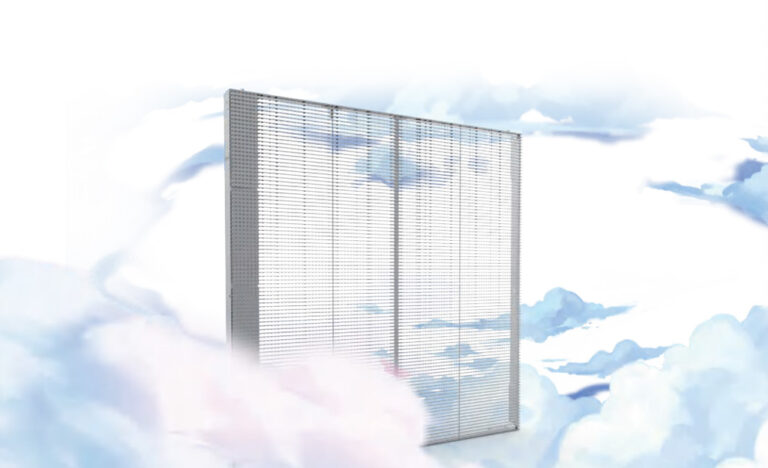
Evidence, experience and a single field observation
I’ve worked on fit-outs where engineers insisted on conservative load margins and designers pushed for maximal translucency; the solutions that lasted combined specification discipline with honest testing. At CES in Las Vegas I examined a side-emitting transparent LED screen, which showed how directional light control can preserve daylight while delivering legible content. That exhibition reinforced three reliable points: measure glazing loads early, specify optical scattering rather than brute opacity, and require on-site mock-ups. The technical choices I recommend are grounded in measured practice, not guesswork.
Why projects fail — common mistakes
Design teams often make the same avoidable errors. They accept vendor visualisations without a scale mock-up; they ignore maintenance access when mounting onto curtain wall mullions; they underestimate thermal expansion where modules abut structural silicone. Another frequent error is choosing high-density panels for daytime façade campaigns when a sparser, side-emitting approach would provide better legibility and far less visual blockage. These mistakes cost time and demand retrofit work that harms both budget and reputation.

Practical alternatives and how to judge them
Options fall into clear categories. Dense backlit LED arrays give high contrast at night but block daylight. Mesh and pixel-sparse systems preserve views but can wash out under bright sky. Side-emitting transparent solutions sit between these extremes: they route emission laterally to keep the panel visually light while delivering higher perceived brightness toward a viewer. Choose by the control variables you can commit to: if you can control ambient glare and want daytime readability, favour directional side-emission; if you need simple night-time signage, a denser LED array will suffice. Ask for on-site proofs and specify measurable targets for transparency percentage, luminous intensity at 1–10 metres, and wind-load certification.
Installation, operation and maintenance — what to demand
Insist on these technical checks before sign-off: mounting points proven to existing façade anchors; serviceable modules that slide out without removing adjacent glass; clear thermal dissipation paths and accessible control electronics. Calibrate content for the chosen viewing zones — animated, high-contrast loops read poorly on highly transparent systems unless designed to exploit perceived depth. For safety, request documented fixation tests and IP-rated connectors for exposed external façades. These are straightforward items; omit them only at your peril.
Final synthesis
When the problem is framed plainly — preserve daylight and views while delivering readable imagery and durable attachment — the correct solution is often a considered, side-directed transparent system paired with rigorous specification and practical mock-ups. That approach reduces retrofit risk, speeds project approval and keeps stakeholders satisfied. For teams wanting a partner that matches those priorities, HDC presents tested modules, mounting methods and service workflows that align with the technical checks described above.