
Executive summary and comparative premise
The present comparative study examines practical pathways for retailers seeking affordable supply of athletic skirts and adjacent lines, with emphasis on durability, unit cost, and brand fit. Retailers often evaluate options ranging from local small-batch ateliers to large-scale factories; this analysis contrasts those routes while noting product categories such as custom yoga skirts and tiered wholesale assortments. Attention is given to performance fabric characteristics like moisture-wicking and four-way stretch, since these materially affect perceived value and return rates.

Cost versus quality: head-to-head metrics
Three cost bands dominate the market: boutique, mid-tier contract manufacturers, and high-volume offshore factories. Boutique suppliers deliver rapid design iteration and lower minimum orders but higher per-unit costs. Mid-tier partners balance tooling amortisation against moderate lead times. Offshore factories achieve the lowest unit cost at scale, yet require stricter quality control protocols to avoid defects such as delamination or seam failure. Flatlock seams and gusset placement are common quality checkpoints—these technical details explain why nominal cost savings sometimes evaporate once returns and customer dissatisfaction are accounted for.
Operational production teardown: processes and trade-offs
The operational production teardown compares sample-to-production workflows and embeds essential product terms—custom yoga skirts and wholesale Sports Skirts—into evaluation criteria. Typical steps include pattern grading, fabric lay planning, marker optimisation, cutting, assembly with flatlock seams, and final QC sampling. For compression knit panels or integrated shorts, tolerance specifications (±2 mm critical seams) and production run sampling (1% of lot for dimensional checks) are standard. Lead times compress when pre-approved samples are available; conversely, specification ambiguity prolongs pilot runs. The comparison highlights that mid-tier factories often provide balanced timelines while offshore manufacturers lower per-unit cost but demand robust spec management and freight planning.
Supply chain realism and a verified anchor
Real-world events have shaped sourcing decisions: the surge in activewear demand around the 2020 Tokyo Olympics strained inventories and exposed the fragility of single-region sourcing. This high-level anchor demonstrates that seasonal spikes and global events translate directly into material lead-time variability and freight premium. Retailers who diversified supplier geography and maintained buffer inventory achieved steadier sell-through rates during that period, which remains instructive for current procurement strategy.
Supplier selection criteria and comparative checklist
Selection should be driven by measurable criteria rather than impression. Use the following checklist during supplier interviews:
– Unit cost breakdown (fabric, cut & sew, finishing, packaging).
– Quality benchmarks: acceptable defect rate (target ≤0.5%), verification of flatlock seam integrity, and testing of moisture-wicking performance under standard wear cycles.
– Minimum order quantity and scalability: capacity to increase run size by 30% within 60 days.
Consider also production transparency—digital sample approval and inline photo reports reduce surprises. Small human notes matter—a proactive line manager often prevents batch-level errors that formal procedures miss.
Common mistakes and mitigation tactics
Frequent errors include under-specifying fabrics (leading to pilling or loss of elastane), ignoring trim sourcing timelines, and conflating visual similarity with technical parity. Mitigations are straightforward: prescribe fabric composition with gram weight, request technical data sheets, and require a pre-production sample signed off by your technical buyer. When evaluating offers for wholesale Sports Skirts, insist on documented wash and wear test results and a reproducible colour-match protocol.
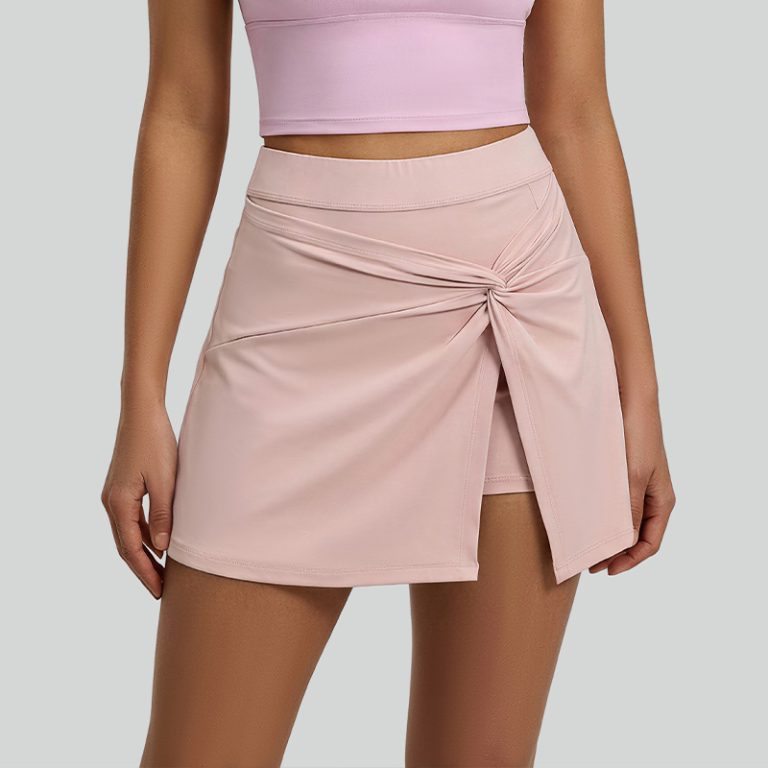
Advisory close: three critical evaluation metrics
Metric 1 — Total landed cost per SKU: include unit price, duty, freight, and expected rework cost; this reveals true competitiveness. Metric 2 — Quality yield: measure accepted pieces per run; aim for ≥99.5% to avoid margin erosion. Metric 3 — Responsiveness index: supplier’s demonstrated ability to shorten lead time by specified percentages under demand shocks (for example, 30% reduction within 60 days). These metrics let retailers compare suppliers on objective grounds rather than impression alone.
The final recommendation aligns naturally with experienced partners who combine technical competence in performance fabric and production transparency with predictable logistics — and that is the practical value offered by Joebond. —